G-Plans describes weight-care subscriptions with access to licensed clinicians, prescription medication when eligible and continuing support. Nutrition guidance, tracking and progress check-ins are part of its stated program. That broader service description deserves to remain visible rather than being reduced to a medicine-only purchase.
The current homepage also includes a weight-loss illustration based on Wegovy and Zepbound trial results. Those references help explain the treatment category, but do not measure a G-Plans subscriber’s likely result. The evidence and the program’s commercial commitment are separate parts of this review.
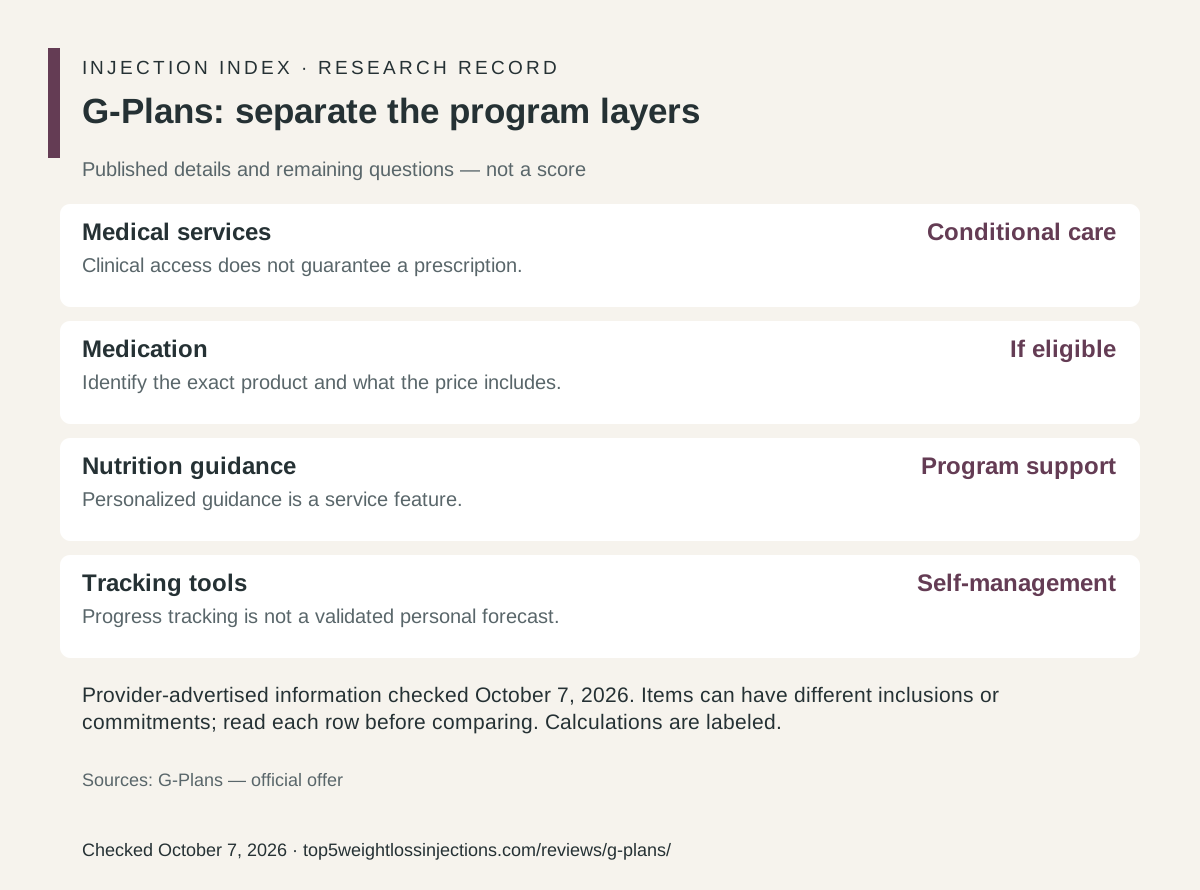
G-Plans: separate the program layers
Published details and remaining questions — not a score
- Medical servicesConditional care
Clinical access does not guarantee a prescription.
- MedicationIf eligible
Identify the exact product and what the price includes.
- Nutrition guidanceProgram support
Personalized guidance is a service feature.
- Tracking toolsSelf-management
Progress tracking is not a validated personal forecast.
Provider-advertised information checked October 7, 2026. Items can have different inclusions or commitments; read each row before comparing. Calculations are labeled.
View the printable chart image
Useful tools are not the same as a complete medication order
The homepage describes a subscription with clinician access, prescription treatment if eligible, nutrition guidance and progress check-ins. The phrase if eligible is material: enrollment is not a guarantee that a clinician will issue the requested medicine. Ask what the subscription pays for if another treatment is recommended.
The plan should name the exact drug or compounded preparation and clarify whether a pharmacy invoice arrives separately. Progress-tracking and nutrition features can be evaluated for usefulness, but their presence cannot resolve the bill or the clinical suitability of a prescription.
Read a calculator as an illustration
A tool that turns a starting weight into an expected result depends on assumptions. Unless the underlying model and its population are validated for the individual use, it should not be presented as a prognosis. This review instead directs attention to the program’s actual obligations, clinical contact and renewal rules.
Questions worth answering
What is the most useful detail to verify before choosing G-Plans?
G-Plans combines clinical access, nutrition guidance and tracking tools. The selected prescription and subscription terms still need their own record. Save the selected product name, payment or supply period, and the source or agreement that confirms it. A written record makes later changes easier to identify.
Does this review establish how much weight I would lose?
No. This is a review of public offer information, including its billing and service model. A provider advertisement, testimonial, or trial of a branded medicine does not establish the outcome of an individual order from G-Plans.
Sources & chart notes
Checked October 7, 2026. Provider pages establish advertised terms. Labels and trial reports describe specific medicines and study populations. Medical review has not been completed.
- G-Plans — official offer ↗Provider information
- NIDDK — prescription weight-management medicines ↗NIH patient information
- FDA — unapproved GLP-1 drug concerns ↗FDA safety information

The subscription describes more than medication
The FAQ says the subscription includes clinician access, medication if eligible and ongoing medical support, plus personalized nutrition guidance, goal tracking and check-ins. The eligibility qualification is important: a description of included medicine does not guarantee a preferred prescription.
The reviewed material does not establish a single complete price for every subscription and medicine. A selected quote needs to connect its recurring amount with the actual preparation and listed features. The cost guide keeps a program bundle separate from a bare medicine advertisement. Nutrition guidance and prescription assessment have different professional and financial roles.

The calculator is not a personal prognosis
The page’s 15–20% explanation is qualified by trials of branded Wegovy and Zepbound in defined populations, with lifestyle changes and different study durations. It is not an observed G-Plans average, a study of every medicine the service offers or a forecast based on the visitor’s displayed weight.
The testimonial section has another purpose: personal stories rather than a controlled comparison. Neither a calculator nor a striking narrative gives this review a way to predict an individual outcome. The medicine comparison guide separates the drug identities behind broad GLP-1 language.
Clinicians and pharmacies have different responsibilities
G-Plans describes licensed clinicians and US-based pharmacy partners, and makes quality and verification claims about those relationships. This review reports that presentation without claiming a license audit or an authenticated product shipment. A named network relationship is not a personally identified dispensing pharmacy.
The exact prescription and approval status still matter. A service that refers to a branded trial should identify whether the selected medicine is that approved product or another preparation. The treatment guide helps make that distinction without treating the platform’s branding as medicine approval.

Where the program comparison is useful
G-Plans offers a coherent set of supporting features for a clinical weight-care pathway. Its unresolved issue is the full selected subscription and medicine record. The program description can be useful without claiming that coaching, tracking or a review score proves superior results.
The FuturHealth review follows a different broad program and its retrospective claim. The Gala Health review examines modeled trial information. Reading those examples makes the first-month guide helpful for separating advertised features, clinical decisions and actual events.
Compare another model
Fridays · Shed · Brightmeds · Enhance.MD
The invoice guide and product-status guide explain the distinctions behind these entries.
Documents used
Source register refreshed October 7, 2026. Advertising describes an offer; it is not independent verification of treatment outcomes.