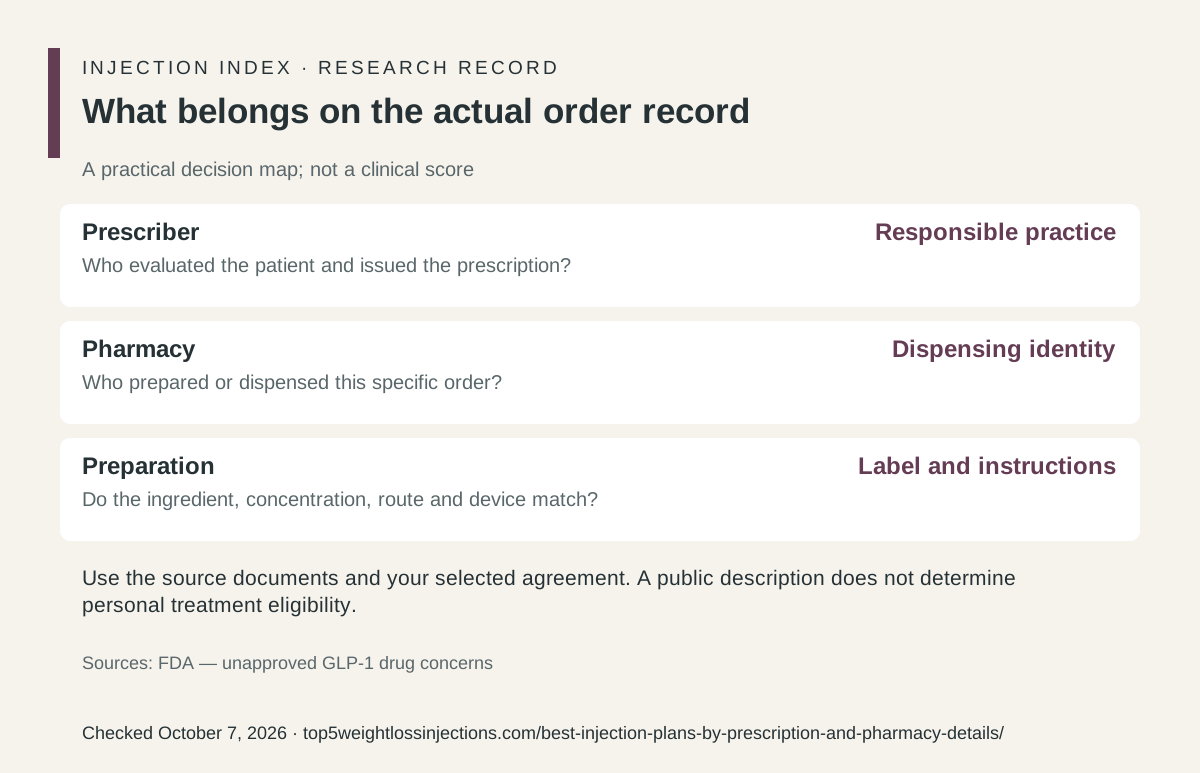
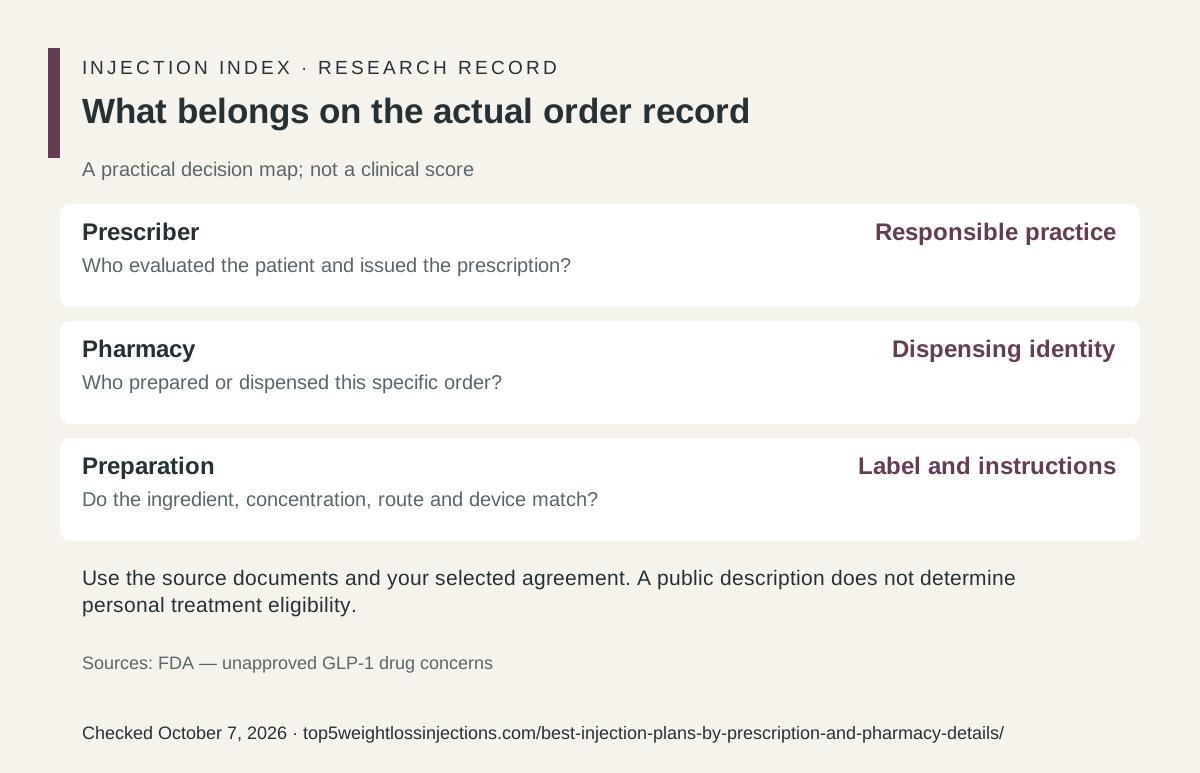
An online plan should lead to a clearly identified prescription and dispensing arrangement. Injection Index compares five routes by those questions, keeping approved products and compounds distinct. An ingredient name or low headline price cannot establish the concentration, source or instructions for the medication actually received.
Follow the clinical decision through to the pharmacy label and the invoice. A provider may offer more than one medication or purchasing arrangement, so its smallest advertised number cannot describe every option. The actual preparation, supply interval and ordinary renewal need to be identified together before care can be budgeted realistically.
Semaglutide $948/year ($79/mo equivalent) or $139 month-to-month; tirzepatide terms differ
Likeness Rx offers compounded semaglutide and tirzepatide with explicit term pricing. Its lowest advertised monthly equivalents are $79 and $129 on annual prepaid terms; month-to-month options cost more.
Read the actual label, not the promotional container
Provider marketing may use representative packaging. The order record should identify the prescribing practice and the pharmacy that supplies the medicine. Confirm the ingredient list, concentration, dosage form and storage directions on that actual record.
FDA has warned about misleading compounded-drug marketing and dosing errors. A facility credential or ingredient name should not be substituted for finished-product approval. If a preparation differs from an approved option, the clinician should explain its individual rationale and instructions.
Before you decide
Questions worth answering
Does the order on this page identify the best treatment for me?
No. It is a publisher-arranged comparison of selected public offers. The chart explains the specific purchase or evidence question; a licensed clinician must assess the actual treatment.
What should I verify for this comparison?
An identifiable prescription and dispensing pharmacy are more useful than a generic claim about trusted partners. Ask for the selected written quote and the product-specific clinical explanation before making a purchase.
Evidence behind this page
Sources & chart notes
Source dates are listed with each document. Earlier research and later offer updates are identified separately. Provider pages establish advertised terms. Labels and trial reports describe specific medicines and study populations. Medical review has not been completed.
Best injection plans by prescription and pharmacy details — use the complete product record to compare formats and purchase terms.
Identify the person and process behind the offer
Obtain the pharmacy identity and actual label, then resolve any unclear administration directions.
Ask who evaluates the clinical or product question, how the requested information is submitted and which contact handles a continuing concern. A shopping or support message may not reach the professional responsible for a prescription. Read the purchase agreement separately so a convenient service feature is not mistaken for a clinical promise. The offer should be understandable without assuming a guaranteed prescription, particular response time or included service that the source does not establish. Read the related care guide for the wider context.
Identify the person and process behind the offer — keep the exact product identity and its complete label together.
1. CoreAge Rx: compare the actual care and medicine
CoreAge provides clinician assessment and a compounded injection pathway with a stated ingredient-specific starting rate. Its product pages separate semaglutide from tirzepatide. The prescription, concentration and amount dispensed should be confirmed rather than inferred from the price or transferred from another provider’s vial instructions. The named semaglutide page provides a clear starting rate and no-membership claim. The actual dispensed amount and repeat-order terms still need confirmation before it becomes a like-for-like price comparison.
Ask what the relevant professional or manufacturer can establish about the actual preparation. A convenient shopping route should not be mistaken for an assessment of individual suitability. The CoreAge Rx review records the purchase model and remaining questions.
The public process involves a medical questionnaire and a clinician’s assessment. Ask how refill reviews occur and how you reach the prescribing team between deliveries. The pharmacy should be identified and able to resolve questions about the label, storage, and written directions. Customer support can track a package; clinical support must address the treatment itself.
For CoreAge Rx, identify the person who can answer the product question that remains after purchase. Use the dated CoreAge Rx review for the offer context. Ingredient clarification, a billing adjustment and a prescription reassessment can require different contacts. Read the included services in the selected agreement and retain the current label so a useful question can be sent to the right place.
2. SuperHealthy Rx — GLP-1 care
SuperHealthy Rx advertises compounded semaglutide from $85/month and tirzepatide from $135/month. The linked offer says the provider visit and shipping are included. Confirm the amount due, plan term and refill settings; a prescription depends on clinician review. These are published service terms, not independently tested outcomes. Read the SuperHealthy Rx review.
SuperHealthy Rx: compare the selected agreement with the questions in this section.
3. Likeness Rx — GLP-1 weight care
Read the preparation and recurring invoice together. Likeness Rx offers online access to compounded semaglutide and tirzepatide. Its public page lists semaglutide from $79/month; tirzepatide from $129/month.
The lowest monthly equivalents accompany 12-month subscriptions: $948 for semaglutide or $1,548 for tirzepatide. One-month plans are $139 and $199. The page says the selected term renews automatically; check the amount due and cancellation date.
The public site describes licensed-provider review, shipping after approval and care-team messaging. Those are service statements rather than measured response times.
These are provider-published terms checked October 4, 2026. Prescription approval is conditional. Compounded medications are not FDA-approved; we have not tested the treatment, pharmacy fulfillment or patient outcomes.
Product and subscription information checked at likenessrx.com on October 4, 2026.
4. Noom Med: compare the actual care and medicine
Noom Med links clinical care with an app and behavior-change resources. It has several distinct medication pathways, including standard compounded, microdose and branded-medication care. The plan name matters because included medicine and regular billing differ; engagement claims do not prove an individual result. Noom’s branded pathway describes insurance and cash-pay access while excluding medicine from its care price. Identify that exact plan rather than importing a microdose or compounded-program promotion into the coverage comparison.
Clarify the product role and who can answer an unresolved question after purchase. A customer-service contact and a clinical prescriber may handle different concerns. The Noom Med review records the purchase model and remaining questions.
Noom’s combination of medical access and behavior support may appeal to someone who wants those services in one program. Ask how medical questions reach a prescriber, what follow-up is included, and which app features remain available under the chosen subscription. A coaching interaction and a prescription review serve different needs.
The care or product route around Noom Med belongs beside its formulation and purchase reference, Plan varies. Ask what happens when a concern changes, how the relevant professional receives a message and which services are included. A convenient first order is valuable when the continuing process is also intelligible; it should not require guessing which support channel can make a clinical decision.
Noom Med: compare the selected agreement with the questions in this section.
5. Ro: compare the actual care and medicine
Ro’s Body route separates a clinical membership from medication. The current page describes access to FDA-approved products, insurance support, provider messaging and care. That structure is useful to compare with medicine-inclusive bundles, while a membership floor alone does not identify the total treatment cost. Ro’s monthly membership is distinct from its prepaid term options. Add the actual medicine quotation, since avoiding annual access prepayment does not identify the separate pharmacy payment period or treatment cost.
The access route should be understandable alongside the label and order agreement. Find out how the person responsible for the product or prescription receives a changed concern. The Ro review records the purchase model and remaining questions.
Ro describes access to prescription weight management care, but the prescribing clinician must decide whether a specific medicine is appropriate. An assessment does not guarantee access to any one brand, insurance payment, or a particular ongoing pharmacy price. Obtain the product name and route rather than treating “GLP-1” as a complete prescription description.
Assess Ro using the actual process described by the supplier, with $39 start as the published order reference. Find the label source, purchase agreement and relevant professional contact before relying on a broad service slogan. Those records make the practical tradeoff clearer than assuming an unlisted feature or treating sales support as a prescription review.
6. RemedyMeds: compare the actual care and medicine
RemedyMeds describes clinician-led access to compounded semaglutide and tirzepatide, with continuing video and messaging support. Its public homepage presents month-to-month arrangements, cancellation options and discreet delivery, and describes pharmacy supply on a 28-day interval. Those are provider statements to verify for the selected plan. The capture does not establish a single reliable current price for every option, so obtain the exact medication, invoice and ordinary renewal. Its outcome and guarantee marketing should be read with the stated conditions; it is not independent evidence that this program will produce a particular result for the reader.
Read the current instructions and identify what information is needed before changing the routine. An efficient purchase cannot supply missing details about the preparation or clinical decision. The RemedyMeds review records the purchase model and remaining questions.
Before enrolling, obtain the medication name, route, formulation, and pharmacy. Compounded treatment should not be described as an FDA-approved generic of a branded injection. Ask the clinician why an approved medicine cannot meet your individual needs and how the proposed preparation addresses that issue.
For RemedyMeds, identify the person who can answer the product question that remains after purchase. Its order reference is See quote. Ingredient clarification, a billing adjustment and a prescription reassessment can require different contacts. Read the included services in the selected agreement and retain the current label so a useful question can be sent to the right place.
The injection order has four separate records — keep the exact product identity and its complete label together.
7. Mochi Health: compare the actual care and medicine
Mochi combines provider access and nutrition-oriented support with a separate medication charge. Its current catalogue distinguishes branded medicines and compounded options. The exact selected medicine and diagnostics are outside the membership, so a product-card floor should not be mistaken for the complete monthly plan. Mochi’s monthly membership can be compared with its new-member introduction, while medicine and diagnostics remain extra. Ask how the medication supply is billed so the complete plan is not mistaken for one flexible access payment.
Compare the process actually described in the current source. Do not assume a feature, included consultation or particular response time solely from the size or familiarity of the brand. The Mochi Health review records the purchase model and remaining questions.
A membership model is most useful when the included care is meaningful to the subscriber. Confirm how appointments, refill reviews, and between-visit questions are handled. Ask which contacts are clinical and which are customer service. A clear follow-up route matters if the medicine is changed or a shipment is delayed.
The care or product route around Mochi Health belongs beside its formulation and purchase reference, $79/mo. Ask what happens when a concern changes, how the relevant professional receives a message and which services are included. A convenient first order is valuable when the continuing process is also intelligible; it should not require guessing which support channel can make a clinical decision.
The injection order has four separate records
Keep the prescription, the pharmacy label, the supply and the invoice together. Each establishes something different: what the clinician selected, what the pharmacy dispensed, how much is supplied and what the reader paid. This is especially useful when the program markets both branded medicines and compounds. An intake form, a product nickname or an advertised monthly equivalent cannot substitute for those four records.
FDA has raised concerns about dosing errors with compounded GLP-1 products. A reader should have the instructions for the actual concentration and device supplied, with a clinician or pharmacist available to resolve an unclear label. Directions from a previous vial or another online service should not be transferred to a new preparation. This comparison focuses on dispensing clarity, follow-up and the complete purchase rather than supply a personal injection schedule or infer a dose from the price of the plan.
Clinical eligibility and the payment decision are separate steps — compare what the payment covers, when it renews and which charges remain separate.
Find the contact that can answer the actual question
Choose a realistic question before evaluating support: a shipping address change, a missing ingredient amount, an unexpected charge or a new clinical concern. Those requests can belong to different people. Ask how the relevant professional or manufacturer receives the message, whether an appointment is needed and what information should accompany it. A live shopping chat can be helpful for purchasing while still being a different route from the person responsible for a prescription.
Keep a copy of the current label, order number and selected agreement so the question can be answered without reconstructing the purchase. Ask which services are included and which require another payment. For medicine decisions, clarify the clinician’s role and the route for reassessment. For a supplement or cosmetic, locate the manufacturer’s label information and the seller’s order terms. A clear contact process is a concrete service feature to compare; the speed or friendliness of a sales reply is a separate observation.
Clinical eligibility and the payment decision are separate steps
NIDDK describes weight-management prescribing as an individual decision that considers potential benefits, possible side effects, current health, other medicines and family history. For adults, its general discussion includes BMI of 30 or greater, or 27 or greater with weight-related health problems. Those are starting clinical considerations rather than an eligibility test supplied by this page. The clinician assesses the actual product and circumstances; a sales offer or membership payment cannot establish the prescription.
Discuss reproductive plans and other relevant changes before enrollment and during care. NIDDK advises against weight-loss medication during pregnancy or when planning pregnancy. Confirm the selected product’s own information with the clinician rather than transfer advice from another preparation. Once the care decision is made, obtain the complete medicine and service invoice, the ordinary renewal and the process for a clinically necessary change. That keeps treatment assessment and financial commitment understandable without making either one substitute for the other.
Are branded medicines and compounds the same finished products — keep the exact product identity and its complete label together.
Is a care membership the same thing as a medication-inclusive plan?
No. A membership can cover assessment, visits, coaching or insurance assistance while a pharmacy charges separately for medication. A direct offer may bundle some of those costs. Ask for the selected plan’s complete invoice and exact product, including delivery and ordinary renewal. Compare what each payment actually buys rather than place an introductory service fee in the medicine column.
Are branded medicines and compounds the same finished products?
They should remain distinct. Manufacturer-branded medicines have their own approved labels, while compounded preparations are not FDA-approved finished products. The pharmacy, concentration, ingredients and directions must be identified for the actual prescription. Trials of a branded product do not establish the results of an unspecified compound. A program comparison should make those identities clear rather than assume equivalence from an ingredient name.
What should happen if the prescription changes after assessment?
Ask the provider how the change affects medication supply, care fees and any advance payment. Those terms belong in the selected agreement and may differ between a membership and a prescription-inclusive purchase. Keep the prescribing contact available for clinical questions and customer support available for the order. A paid renewal or shipment notice is not, by itself, confirmation that the same treatment remains appropriate.
Prepare a complete comparison before enrollment
Put the answers beside the actual label and selected order. Keep any unresolved formula, supply or renewal question visible before deciding whether this option fits the routine.
Original references are retained below. Later observations and their source dates are identified in the dated updates and research notes. Advertising describes an offer; it is not independent verification of treatment outcomes.