Semaglutide and tirzepatide appear in approved branded medicines and in some compounded preparations. An online offer can mention an ingredient without fully identifying the prescription product. The first useful question is what the clinician proposes to prescribe and what the pharmacy will actually dispense.
Compounded drugs are not FDA-approved. FDA does not review them for safety, effectiveness, or quality before marketing. They should not be described as approved generics of Wegovy or Zepbound. This distinction belongs in the purchase decision alongside price and convenience.
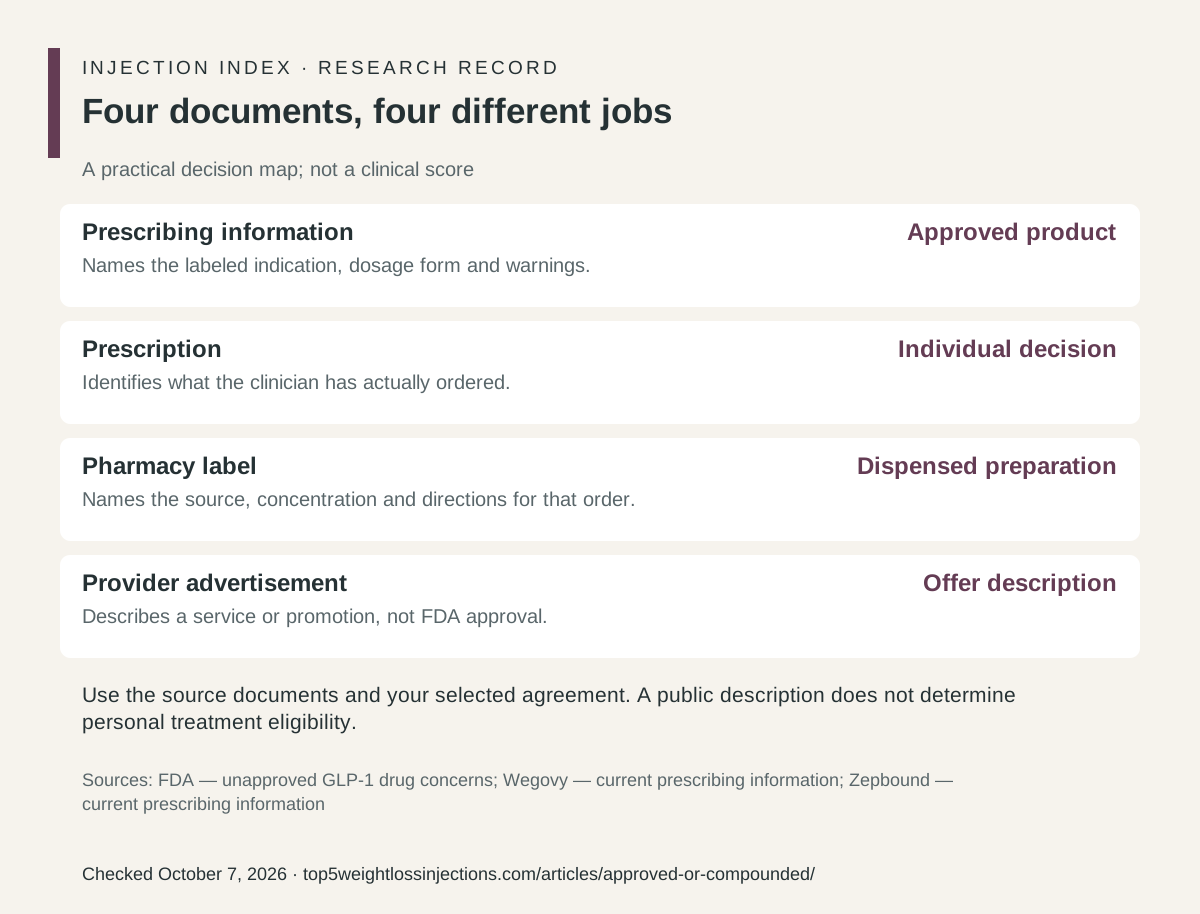
Four documents, four different jobs
A practical decision map; not a clinical score
- Prescribing informationApproved product
Names the labeled indication, dosage form and warnings.
- PrescriptionIndividual decision
Identifies what the clinician has actually ordered.
- Pharmacy labelDispensed preparation
Names the source, concentration and directions for that order.
- Provider advertisementOffer description
Describes a service or promotion, not FDA approval.
Use the source documents and your selected agreement. A public description does not determine personal treatment eligibility.
View the printable chart image
Keep approval attached to the finished medicine
A licensed pharmacy, a registered facility and a brand-name ingredient are not interchangeable evidence of finished-drug approval. FDA explains that compounded drugs do not undergo the same premarket review for safety, effectiveness and quality. If compounding is proposed, ask why an approved product does not meet the individual clinical need.
The current Wegovy information covers more than one dosage form. Zepbound has its own presentations and instructions. A prescription should identify the actual version; neither a vial photograph nor the word semaglutide answers that question. A change in concentration or delivery device is a reason to obtain fresh instructions from the clinical or pharmacy team.
Questions worth answering
How should I use the chart on this page?
Use the source documents and your selected agreement. A public description does not determine personal treatment eligibility.
What should I keep after comparing my options?
Save the named product, the relevant source or agreement, the full payment and renewal details, and the clinician or pharmacy contact. Use the chart as an organizer for questions; it does not replace the selected contract or a medical assessment.
Sources & chart notes
Source dates are listed with each document. Earlier research and later offer updates are identified separately. Provider pages establish advertised terms. Labels and trial reports describe specific medicines and study populations. Medical review has not been completed.
- FDA — unapproved GLP-1 drug concerns ↗FDA safety information ·
- Wegovy — current prescribing information ↗FDA-approved labeling ·
- Zepbound — current prescribing information ↗FDA-approved labeling ·
- NIDDK — prescription weight-management medicines ↗NIH patient information ·

For a branded product, use the official product information
Wegovy and Zepbound have their own official prescribing and safety information. Discuss the actual product, route, eligibility, contraindications, and monitoring with the clinician. A website comparison cannot determine whether either medicine is suitable for you.
Clinical research on an approved medicine evaluates that studied product under particular conditions. It is not a guarantee of an individual result. The Wegovy profile and Zepbound profile point readers toward official product information rather than treating a brand name as a universal recommendation.

For a compounded preparation, ask for the individual rationale
FDA says compounded drugs should be used when a patient’s needs cannot be met by an approved drug. Ask the prescriber why compounding is being considered for your circumstances. Price alone does not establish that the preparation is interchangeable with an approved product.
Request the ingredient list, route, concentration, amount supplied, and dispensing pharmacy. Added substances or a different delivery form deserve their own explanation. A trial of a branded injection does not validate every blend or route described with the same ingredient name.
Treat labeling and directions as essential information
The pharmacy’s label and written directions should be understandable before use. FDA has reported dosing errors with compounded GLP-1 medicines. A vial concentration and a syringe marking cannot be interpreted safely from another patient’s instructions or a generic internet conversion.
If the directions are unclear, contact the pharmacist or prescribing clinician before taking the medicine. Ask who handles a damaged package, temperature concern, or missing label. A favorable provider review cannot establish that a particular shipment is safe to use.

Keep the product choice connected to follow-up
Obtain a route to the prescribing team and understand how refill suitability is reviewed. New symptoms, changed medicines, and treatment adjustments belong in that clinical process. Administrative customer service may not be the right channel for a medication assessment.
Use the clinical conversation guide before enrollment and the first-month checklist after a plan is agreed. The goal is a clearly identified prescription and a workable care process, rather than confidence based only on a brand or ingredient headline.
Compare named offers for this decision
For current named options, read Cheapest tirzepatide injection plans: offers beyond the lowest monthly number and Best GLP-1 programs with nutrition and coaching: support models to compare.
Use the offer details
Open the CoreAge Rx review, GLP-1 program index, and cost table to continue your comparison. Medical suitability should be discussed with a licensed clinician.
Documents used
Original references are retained below. Later observations and their source dates are identified in the dated updates and research notes. Advertising describes an offer; it is not independent verification of treatment outcomes.